Devlog #16 — The house inside, the named monster and the classic rules
Since Devlog #15 there have been three updates — two on the 16th and this Sunday’s, October 18. Everything here is already in the game: just open it through the launcher.
First things first: the Crystal fell
This Sunday, at 2:50 pm (Brasília time), the army of evil brought the Crystal down, and the world ended — as the rules say. With so few people playing for now, it wasn’t a fair fight: we rolled the world back to the save from 3:25 am that same day, with characters, items and buildings. What was done between 3:25 am and 2:50 pm was lost; we’re sorry.
And, for now, the Crystal is protected: evil keeps growing, colonizing and taking mines, but it doesn’t march on it. When there are enough people to defend it, the protection goes away — with a warning first.
The house inside

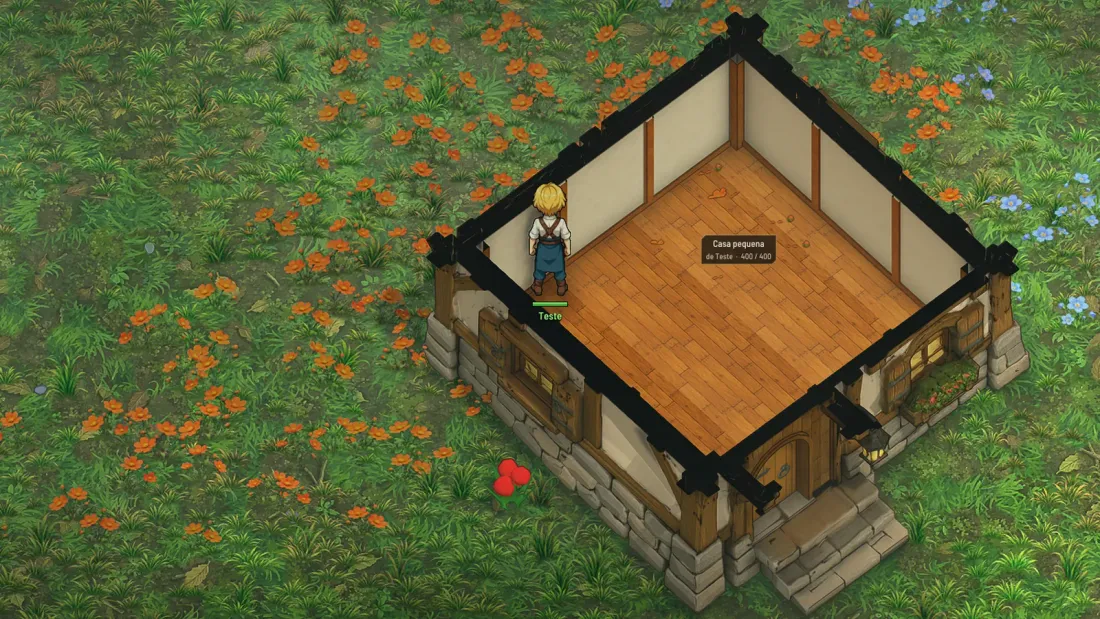
The small house is no longer a shell: now you can walk into it.
- The door opens with F. The hint shows up when you get close. For the owner and their guild, it opens on its own as they arrive.
- When it’s closed, only the owner and their guild get through — and it blocks the view of whoever is outside. Open, or broken down, anyone can come in.
- Inside, the roof opens up to show the room and its wooden floor. Furniture comes later, made by Merchants.
- The kit’s quality now counts on the house: a well-made kit raises a sturdier house — and door — than a shoddy one.
The named monster
The creature that kills a player doesn’t go back to being just another creature:
- It levels up with every kill (more so when the victim is strong), getting stronger and tougher.
- It earns a title for its kills — Hungry, Devourer, Scourge and Legend — and a nameplate.
- It swallows its victim’s loot bag: what death took walks around with it, and drops whole when it falls. Avenging a friend now gets their things back.
- It becomes a hunt on the Arrival Board on its own, with its position updated every minute.
- With three kills, it gathers a pack. And its soul drops more often with every victim.
- When it falls, the whole server hears about it.
The classic MMORPG formulas
Combat and attribute rules are now those of the classic MMORPG that inspires the game, all of them:
- A hit’s damage is your attribute attack plus the weapon’s, and only the weapon part varies — Dexterity and the weapon’s level narrow that range.
- Critical hits, perfect dodge, defense (equipment, as a percentage, plus Vitality’s) and magic defense follow the classic formulas.
- HP and SP come from each class’s table, as in the classic: 40 HP at level 1. Skill SP costs came down with it.
- Attribute points are the classic’s: 48 at level 1, more each level, and each point costs more the higher the attribute already is (up to 99).
- Monsters moved to the same scale: a creature of your level goes down in about six hits — and takes you down in about seven.
Experience and job levels stay our own.
The world
No more climbing cliffs
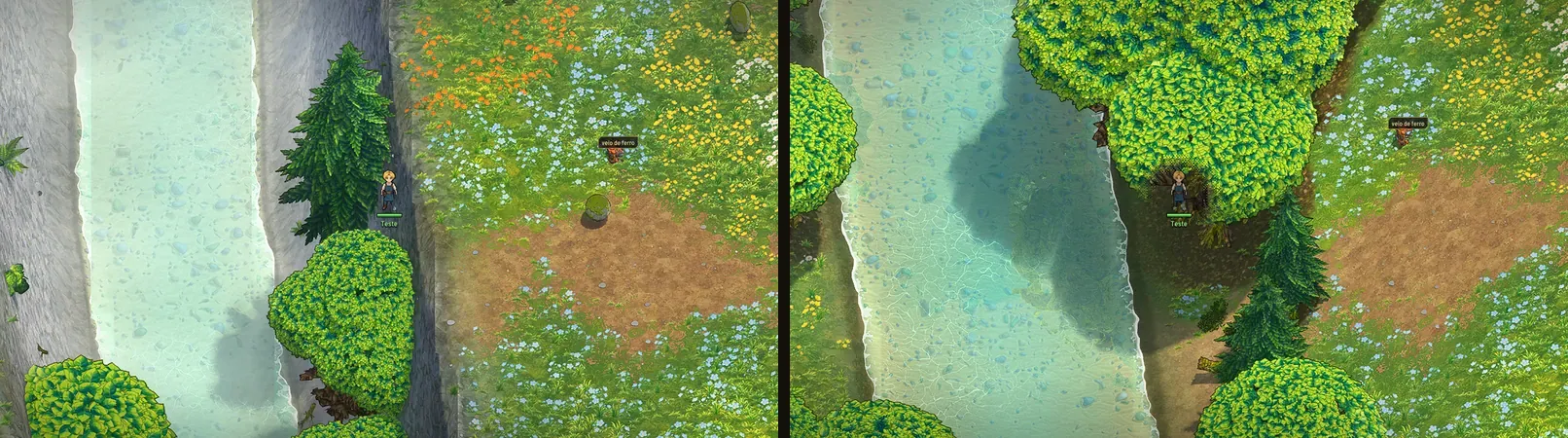
Characters were climbing cliffs they shouldn’t — and riverbanks were walls that didn’t look natural. Now a riverbank is a slope, wider the deeper the river (gentler on soil, steeper on rock), and anything too steep can’t be climbed on foot, across the whole map. Left, before; right, now.
And, at a player’s request, wide rivers got stone bridges every 800 meters: nobody has to walk for an hour to find a crossing anymore.
The desert, remade
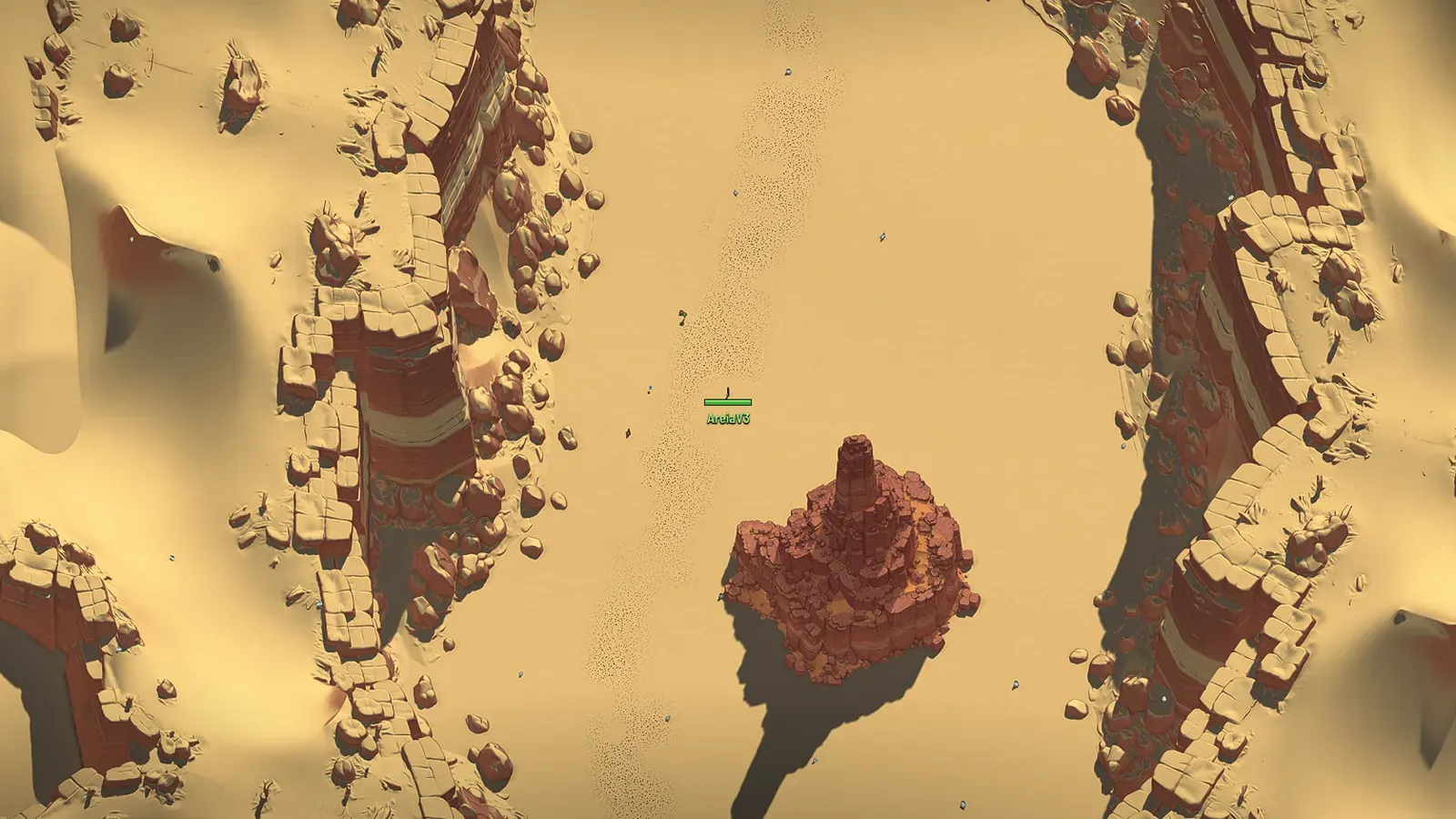
The desert sand was remade: it’s continuous now, dunes have crests and climb up the edges of the Great Gorge, which got new stone mesas and walls.
The castle appears when you walk through its gate

What has never been explored is black — and so was the castle: it showed up piece by piece as you walked around inside. Now, when you walk through its first gate, the whole castle appears at once, on the map and on screen.
And more
- Trees: exposed roots now show only on the oak and the round tree (pines sitting on a ring of roots made no sense), and the round tree’s leaves are now the size of the oak’s.
- Cliffs lost the triangle pattern that showed on the rock.
- The Merchant’s cart shows up right when you log in: before, the old box-shaped cart sat loose on the ground for a few seconds until the new one arrived.
Mining

The Adventurer’s mining got smooth: the pickaxe swing now uses every drawing from the video it came from — he grabs the pickaxe, raises it over his head and drives it into the rock, without the jumps it had before.

And the Merchant got his own, in the same style. The Mage’s is almost ready and arrives in one of the next updates.
Performance, for more modest PCs
Players told us about frame drops, and this was the biggest front of these updates:
- Automatic quality now picks by the graphics card’s power, not just its memory: cards without ray tracing (GTX 10 and 16, older AMD) start on Medium with 6 GB or more, and on Low with less.
- On Low and Medium, the automatic upscaler is FSR, lighter than DLSS at those settings. In the forest, Medium got about 30 % faster in our measurements.
- Dynamic resolution: on automatic quality, Low and Medium, when the card can’t keep 60 frames, the scene shrinks a little on its own, and comes back when there’s room. If you picked High or Ultra, you keep what you picked.
- Low got much lighter: lighter textures and models, and almost half the video memory.
- The first session after an update no longer tanks the frame rate: the game uses a light version of the characters while it prepares the full one.
- On a dual-core PC, the forest runs at twice the frame rate, with fewer stutters.
- The oak got lighter (a player showed it was dropping frames, and it was).
- The launcher retries on its own when the internet drops in the middle of an update.
Found something odd? F9 sends a report straight to the team — or tell us on the forum and on Discord.
See you in the next devlog!
Enjoying the journey? The game is made with no shop and no ads.
Support the project